


When a yacht enters the brokerage market, buyers rarely look at a single factor in isolation.
Hull condition matters. Engine hours matter. Maintenance history matters. So do layout, design, location and market demand.
But there is another part of the equation that is sometimes overlooked: the equipment installed on board.
Marine equipment doesn’t automatically determine a yacht’s resale price. But it can influence how the vessel is perceived, how it is used, and how confident a prospective buyer feels about its condition and future maintenance.
Equipment as a Signal of Specification Quality
Visible equipment can tell buyers something about how a yacht was originally specified.
A well-integrated platform, tender lift or deck system can contribute to the overall impression of engineering quality and attention to detail. Conversely, equipment showing corrosion, excessive wear or poor integration can raise questions even beyond the component itself.
For brokers and buyers comparing similar yachts, these details can become part of the overall assessment of condition and value.
Functionality Is Part of the Value Proposition
Equipment also affects what a yacht can actually do.
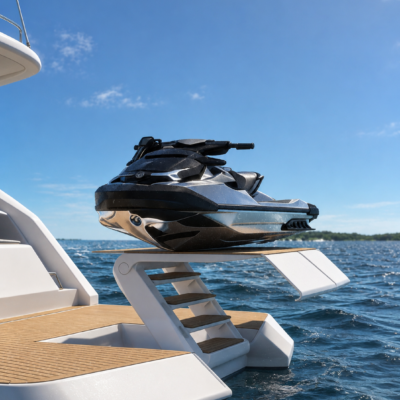
A tender lift can make launching and retrieving a tender significantly more practical. A well-designed swim platform can improve access to the water. A hydraulic deck system can transform how owners use previously underutilized space.
These aren’t simply technical specifications.
They are part of the ownership experience.
And when two otherwise similar yachts offer different levels of functionality, that difference can influence which one a buyer prefers.
Reliability Protects More Than the Equipment
Marine environments are demanding. Saltwater, UV exposure, vibration and repeated use place continuous stress on equipment.
For a second-hand buyer, the question isn’t only “Does it work today?”
It’s also:
How well has it been built? How has it been maintained? And what will it cost to keep it working?
This is where material selection, engineering, and serviceability become important.
Marine-grade materials and properly engineered systems don’t guarantee a higher resale price. But they can reduce concerns around future maintenance and help preserve the condition and functionality of the yacht.
The Long-Term Effect of a Specification Decision
For shipyards and OEMs, this is the part worth considering.
An equipment decision made during construction doesn’t disappear when the yacht leaves the shipyard.
It becomes part of the vessel’s lifecycle:
Specification → Construction → Delivery → Ownership → Maintenance → Resale
The initial purchase price is only one part of that equation.
The quality, reliability, and serviceability of the equipment can influence the experience at every stage that follows.
Building for More Than Delivery Day
At Hydreco Marine, we believe marine hydraulic equipment should be designed for the entire lifecycle of the yacht, not simply for the day it leaves the shipyard.
That means engineering for the marine environment, selecting appropriate materials, manufacturing in-house, and remaining available when support is needed long after installation.
Because the best specification isn’t necessarily the cheapest component on delivery day.
It’s the one that continues to make sense years later.